
GLM API · MIT LICENSED · SERVED FROM THE US
Own the model your product runs on.
The GLM API you already know how to call, on weights you actually own. GLM-5.2 beats GPT-5.5 at resolving real GitHub issues, costs a fraction as much, and is published under an MIT license, so nobody can reprice it, retire it, or cut you off. Hoonify serves it from US infrastructure with nothing retained.
$1.40 per million tokens in, $4.40 out. $2,500 in credits to move your first production route, and we run the eval against your prompts before you migrate anything. Two strings change in your client.
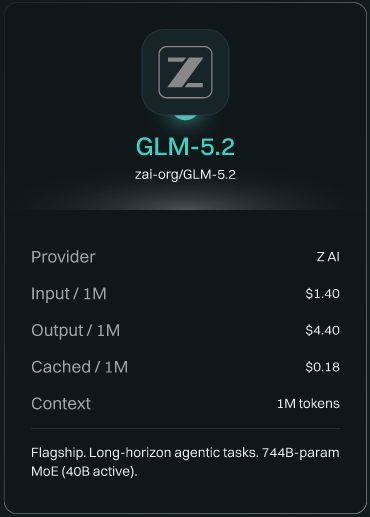
MIT licensed, so the weights are published and yours to keep. Download them, pin the version, and run them here or on your own hardware. Nobody can reprice or retire what you already hold.

The deprecation tax is a real line item. Most teams have paid it twice.
When a model you do not own gets retired or repriced, the invoice does not come from your vendor. It comes out of your roadmap. Here is what it actually costs, and not one line of it ships a feature.
Three ways the bill arrives
They reprice it
Your unit economics get set by someone else's pricing page. You find out the same morning your customers do, and the margin was already spent.
They retire it
A deprecation notice arrives, the endpoint goes read-only, and the prompts and evals you tuned for nine months now target a model that no longer exists.
They cut you off
Rate limits, region restrictions, an acceptable-use review, a policy change upstream. Access is a permission, and permissions get revoked.
Two things open weights let us promise
Nobody can retire what you hold
GLM-5.2 is MIT licensed. The weights are published, downloadable, and yours to keep. If Hoonify raised prices tomorrow you could take the same weights to your own hardware and keep the same API contract. We would rather earn the renewal than hold the exit.
Nobody can move it under you
Pin a version and it stays exactly the model you evaluated. On dedicated capacity and in private deployments you validate a specific set of weights and those keep serving until you decide otherwise. On shared serverless we hold a version for a defined window and tell you before it moves. Closed providers structurally cannot offer this, because they never hand you the artifact.
Move one route. Keep the credits either way.
- Up to $2,500 in inference credits, spendable on GLM-5.2 or anything else in the catalog. No credit card to start.
- The eval, run by us. Send the prompts, we run them through GLM-5.2 and your current provider, and send back the diff plus cost per finished task. Before you change anything.
- An engineer, not a closer. Someone who has done this migration sits on the first call and reads your eval output with you.
- The Switch Guarantee: if it does not hold up on your traffic we will say so. You have moved nothing, spent nothing, and the credits stay in your account.
Claim Your GLM-5.2 credits
It wins on shipping code. It trails on general reasoning. You should know both.
GLM-5.2 is a 744B-parameter mixture-of-experts model with 40B active, released June 13, 2026 and trained for long-horizon agentic coding. Most vendors show you the benchmarks they win. Here are the ones we win and the one we do not, in the same table. model card ↗
| Benchmark | GLM-5.2 | GPT-5.5 | Claude Opus 4.8 | What it measures |
|---|---|---|---|---|
| SWE-bench Pro | 62.1 | 58.6 | — | Resolving real GitHub issues end to end |
| Intelligence Index v4.1 | 53 | 56 | 57 | Broad reasoning, independently scored |
The SWE-bench Pro figure is vendor-reported by Zhipu. The Intelligence Index is scored independently, and it is the one where GLM-5.2 comes third behind Opus 4.8 and GPT-5.5. Two rows, one of them against us, because that is the honest shape of it. source ↗
The number that decides your invoice
GLM-5.2 thinks out loud. On a typical agentic task it emits about 43,000 output tokens, roughly 37,000 of them reasoning, against about 16,000 for GPT-5.5. Per token it is far cheaper, and cached input runs $0.18 per million. Per finished task the gap narrows. Measure finished tasks, which is what the eval harness counts.
You are late to open models and early to this one
Open-weight models carried 29% of tokens through Vercel's production gateway in June 2026, up from about 11% in April, while taking under 4% of the spending. Open-source share of enterprise usage actually fell to 11% in 2025 from 19%, on governance and residency rather than quality. GLM-5.2 only shipped June 13. gateway data ↗ · Menlo ↗
Open weights are Chinese. The hardware does not have to be.
GLM-5.2 comes from Zhipu AI, a Chinese lab. For most vendors that sentence ends the conversation. Here is the distinction that matters, because it is the one your security reviewer will ask about.
Calling z.ai sends your prompts to China
Zhipu has been on the US Commerce Department's Entity List since January 16, 2025, with a presumption of denial. Sending controlled technical data into a listed entity's hosted API is an export, and the kind that gets presumptively denied. Your prompts also sit outside US jurisdiction.
Downloading MIT-licensed weights is not an export
The weights are published openly with no regional restrictions. Running them on US hardware involves no transaction with a listed entity, no data leaving US soil, and no foreign jurisdiction over your prompts. Same model, completely different compliance profile.
| How you reach GLM-5.2 | Where your prompts go | Transaction with a listed entity | Data leaves your jurisdiction |
|---|---|---|---|
| z.ai hosted API | Chinese infrastructure | Yes | Yes |
| Download and self-host | Your hardware | No | No, and it is yours to operate |
| Hoonify | US infrastructure, ours or yours | No | No, and nothing is retained |
Entity List addition, Federal Register, January 16, 2025 source ↗ · Hosted-API versus open-weight export exposure source ↗
Requiring that all inference, including open-weight runs, stays on approved U.S.-based infrastructure is the most defensible near-term posture.
Compliance guidance for US enterprises evaluating open-weight models source ↗
We did not write that sentence. It is a fair description of what we sell.
Nobody goes air-gapped on a Tuesday afternoon.
Most vendors make you commit to the far end before you have proven the near one. Hoonify serves the same OpenAI-compatible endpoint at both, so the distance between them is a config change rather than a rewrite.
Shared serverless, today
GLM-5.2 on api.hoonify.ai. Multi-tenant US capacity, zero retention by default, no GPUs to manage. Create an account and you are making requests in minutes. This is where your $2,500 gets spent, with no commitment.
Air-gapped on-premises, sovereign
TurbOS on hardware you own, disconnected from the internet, in a facility you control. The configuration Hoonify was built for before it was an API company, and the one national labs and defense programs run today. No network required.
Start on the left this afternoon. The code you write today runs unchanged on the right. If you need dedicated capacity or your own cloud somewhere in between, talk to our engineers directly and skip the credits.
The GLM API is OpenAI-compatible. The integration is an afternoon.
Hoonify serves the GLM API on an OpenAI-compatible endpoint, so there is no infrastructure to set up and no migration project. Two strings change in your client. Most teams are running their first request the same afternoon they decide to try.
That is the whole migration. Same SDK, same request shape, your code keeps working as it is.
Drop into what you already use
The GLM API here works with the OpenAI SDKs, LangChain, LlamaIndex, and the tools your team already runs. Streaming, function calling, and structured outputs included.
Nothing to provision
Serverless by default. No clusters to stand up, no capacity planning, no reserved instances, no idle spend, and no on-call burden for a GPU fleet you did not want to run.
Warm on the first call
Request routing and model-weight caching put your call on warm capacity fast, and GPU scheduling scales from your first request to peak volume on its own. New open models go live here the day they launch.
Try it before you tell us who you are
Run GLM-5.2 live in the browser, compare its answers against your current model, and copy the request straight into your app. No account, no credit card, no form.
This is not for you if
An audience that reads pricing pages and diffs terms of service deserves the disqualifiers up front.
You need broad reasoning, not coding
Opus 4.8 measures higher on the Intelligence Index, and we host neither it nor GPT-5.5. If general reasoning is the job, GLM-5.2 is the wrong pick and we will tell you so on the first call.
You want the cheapest GLM endpoint anywhere
A few gateways undercut us on the per-token price. None of them serve it from US infrastructure with nothing retained. If price is the only axis, take theirs.
Changing a base URL takes six weeks here
If a config change at your company needs a change-control cycle, the migration is not the constraint. Start the paperwork before you claim the credits, and we will hold them.
Start with one route.
Nobody rips out a working stack over a deprecation notice, and you do not have to. Pick the one pipeline where price or retention bothers you most. Send us its prompts. Run the eval side by side for a week. If the quality holds, and you should check for yourself, move the next one. Everything else in your stack stays exactly where it is.
Run your own numbers.
Joel Long at Rook rebuilt a dashboard for about $60 instead of $600. GLM-5.2 here is $1.40 per million input tokens and $4.40 per million output. Enter your blended rate from last month's invoice, not a list price, and this does your version of that arithmetic.
Blended rates assume an even split of input and output tokens. Your mix will differ, and with GLM's reasoning output it usually skews toward the output rate. Independent analysis puts GLM-5.2 at roughly one-sixth of GPT-5.5's cost on comparable long-horizon coding work.

The Switch Guarantee
Before you migrate anything, send us the prompts from the route you are considering. We run them through GLM-5.2 and your current provider, and send you the diff plus the cost per finished task. You decide from your own output, not our benchmark.
If it does not hold up on your traffic we will say so, and you have moved nothing and spent nothing. The credits stay in your account either way, to spend on any model in the catalog or not at all. No claw-back, no commitment, and nothing after the voucher code is conditional on talking to us again.
I rebuilt a dashboard that ties together my accounting, my CRM, everything, far more complex than what I had built before with Codex, and it cost about $60 instead of $600 in tokens. If not less.
It ran so fast I thought it was broken.
Hoonify TurbOS was delivered as a private cloud solution and improved their time to results by 20×.
We can reduce our initial analyst load by more than 90%. Our future is all the brighter thanks to Hoonify's involvement.
The questions we get on the first call.
Does my data go to China if I use GLM on Hoonify?
No. We serve the published weights from US infrastructure. Your request reaches our GPUs, gets processed, and is discarded. There is no call to z.ai, no telemetry to Zhipu, and no prompt storage anywhere in the path. The only relationship between Hoonify and Zhipu is that we downloaded a public file they released under an MIT license.
Zhipu is on the Entity List. How is this allowed?
Zhipu was added to the Commerce Department's Entity List on January 16, 2025, with a presumption of denial. That restricts exports and transactions with the listed entity. It does not restrict openly published weights, and running those weights on your own or our hardware involves no transaction with Zhipu at all. The exposure people worry about comes from sending prompts into a listed entity's hosted API, which is exactly what serving the weights domestically avoids. Federal Register ↗ · export-control analysis ↗
A joint House Homeland Security and Select Committee on China inquiry opened in April 2026 into how companies route requests to Chinese models, so a documented residency answer is worth more now than it was last year. Separately, self-hosting removes the provider layer and not the model layer: NIST has documented behaviours embedded in open weights, and those run on your hardware wherever it sits. Evaluate the model itself and keep a human checkpoint where the stakes justify one.
We are a GPU company, not a law firm. If you handle export-controlled technical data, put your deployment plan in front of your export-control counsel, and we will join that call.
What is the catch on the guarantee?
There is not one, because it costs us less than the alternative. If GLM-5.2 does not fit your workload, the expensive outcome for us is a customer who migrates, churns in a quarter, and tells people it did not work. Telling you early is cheaper than that. The credits are already spent from our side the moment the voucher is issued, so there is nothing to claw back and no reason to argue with you about whether your evals were fair.
Can I pin a version so it never changes under me?
Yes, on dedicated capacity and in private deployments. You validate a specific set of weights and those are the weights that keep serving until you decide otherwise. On shared serverless we keep a version pinned for a defined window and tell you before it moves. This is the part closed providers structurally cannot offer, because they do not hand out the artifact.
What exactly do you log?
Timestamp, model name, token counts, HTTP status, and latency. That is the complete record: no prompt field, no completion field, no training copy, nothing to leak or subpoena because nothing is written. Zero data retention is the default on every account, with no tier to buy and no approval to request.
How do the credits actually reach me?
Submit the form, create an account, and your account executive sends a one-time voucher code. Credits apply to inference on any Hoonify model. When they run out you keep paying list price or you stop. Your old API key is still in your environment, and moving back is the same two-string change that got you here.
Own the model. Choose the metal.
Frontier coding quality, weights nobody can take back, a path that runs from this afternoon to an air-gapped facility without changing your code, and up to $2,500 to find out whether any of that is true for your workload.
Get $2,500 in credits →