
QWEN API · APACHE 2.0 · SERVED FROM THE US
AI independence is cheaper than dependence.
The Qwen API you already know how to call, on weights you actually own. Qwen3.6-27B is Apache 2.0, so the weights are published and yours to keep, and nobody can reprice it, retire it, or cut you off. It lands within four points of Claude 4.5 Opus on every benchmark Alibaba published and beats it on GPQA Diamond.
$0.32 in, $3.20 out, $0.15 cached, served from US infrastructure with nothing retained. $2,500 in credits to move your first production route, and we run the eval against your prompts before you migrate anything.
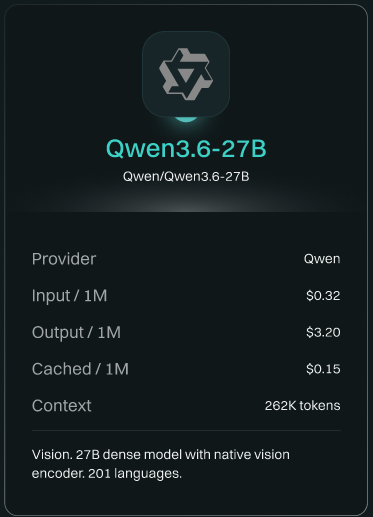
Apache 2.0, so the weights are published, patent-granted and yours to keep. Download them, pin the version, and run them here or on your own hardware. Nobody can reprice or retire what you already hold.

The deprecation tax is a real line item. Most teams have paid it twice.
When a model you do not own gets retired or repriced, the invoice does not come from your vendor. It comes out of your roadmap. Here is what it actually costs, and not one line of it ships a feature.
Do the arithmetic yourself. At a $175,000 fully loaded engineer, one week costs about $3,400, so a four-week migration is roughly $13,500 before the compliance calendar. Substitute your own salary number and the shape does not change: it is five figures, it recurs, and it never appears on a vendor invoice.
Three ways the bill arrives
They reprice it
Your unit economics get set by someone else's pricing page. You find out the same morning your customers do, and the margin was already spent.
They retire it
A deprecation notice arrives, the endpoint goes read-only, and the prompts and evals you tuned for nine months now target a model that no longer exists.
They cut you off
Rate limits, an acceptable-use review, a policy change upstream. Access is a permission, and permissions get revoked.
All three have the same root cause. You are running a model you do not hold. The invoice, the sunset date and the access terms all sit with someone else, and none of them move on your timeline. Open weights do not make the price go away. They change who decides.
Two things open weights let us promise
Nobody can retire what you hold
Qwen3.6-27B is Apache 2.0. The weights are published, downloadable, patent-granted and yours to keep. At 27 billion parameters dense it also fits on hardware a normal company can actually buy, so if Hoonify raised prices tomorrow you could take the same weights in-house and keep the same API contract. We would rather earn the renewal than hold the exit.
Nobody can move it under you
Pin a version and it stays exactly the model you evaluated. On dedicated capacity and in private deployments you validate a specific set of weights and those keep serving until you decide otherwise. On shared serverless we hold a version for a defined window and tell you before it moves. Closed providers structurally cannot offer this, because they never hand you the artifact.
Which is also how to read the credits on this page. Against a $13,500 line item that comes back, up to $2,500 is not a discount on tokens. It is us paying you to stop having to pay it.
Get the eval harness before you get the pitch
The migration guide, the closed-to-open model mapping, and the eval script that measures cost per finished task on your own prompts. PDF plus script, straight to your inbox.
Move one route. Keep the credits either way.
- Up to $2,500 in inference credits, spendable on Qwen3.6-27B or anything else in the catalog. No credit card to start.
- The eval, run by us. Send the prompts, we run them through Qwen3.6-27B and your current provider, and send back the diff plus cost per finished task. Before you change anything.
- The Switch Kit: migration guide plus the closed-to-open model mapping, including the tool-calling, vision and structured-output edge cases.
- An engineer, not a closer. Someone who has done this migration sits on the first call and reads your eval output with you.
- The Switch Guarantee: if it does not hold up on your traffic we will say so. You have moved nothing, spent nothing, and the credits stay in your account.
Claim Your Qwen3.6-27B credits
Seven benchmarks. Six of them within four points. One of them a win.
Qwen3.6-27B is a 27-billion-parameter dense model with a native vision encoder, released April 2026. Here is every benchmark Alibaba published against Claude 4.5 Opus, including the five where it comes second. model card ↗
| Benchmark | Qwen3.6-27B | Claude 4.5 Opus | Gap | Qwen3.5-27B |
|---|---|---|---|---|
| GPQA Diamond | 87.8 | 87.0 | +0.8 | 85.5 |
| Terminal-Bench 2.0 | 59.3 | 59.3 | tie | 41.6 |
| LiveCodeBench v6 | 83.9 | 84.8 | −0.9 | 80.7 |
| AIME 2026 | 94.1 | 95.1 | −1.0 | 92.6 |
| MMLU-Pro | 86.2 | 89.5 | −3.3 | 86.1 |
| SWE-bench Pro | 53.5 | 57.1 | −3.6 | 51.2 |
| SWE-bench Verified | 77.2 | 80.9 | −3.7 | 75.0 |
Every figure here is vendor-reported by Alibaba on its own model card, which is the weakest kind of benchmark evidence and the reason we run your prompts instead of asking you to trust this table. Independent scoring for this model was not available when we published. The last column is the previous generation, so you can see how fast the gap is closing.
What a four-point gap costs you
Frontier pricing is not four percent higher than $0.32 per million in. It is an order of magnitude. That is the trade this page is asking you to price: a gap you can measure in single digits on published benchmarks, against a bill you can measure on your invoice. The eval harness tells you which side of it your workload sits on.
Two things the table does not show
It has a native vision encoder, so image and document inputs go through the same endpoint rather than a second vendor. And it covers 201 languages, which matters if your pipeline sees anything beyond English. Neither shows up on a coding benchmark and both change what you can retire.
Where it runs is a decision you get to make.
With open weights the model and the metal are two separate choices. You pick the model on quality and price. You pick where it runs on residency and control.
US infrastructure by default
Every request to api.hoonify.ai is served from US capacity. Your prompts stay under US jurisdiction, and you get a documented answer when a security reviewer asks where inference happened.
Nothing retained
Requests are processed and discarded. There is no stored prompt corpus to train on, leak or subpoena. Zero retention is the default on every account, with no tier to buy and no approval to request.
Or your own building
A 27B dense model has a footprint most companies can host themselves. Same OpenAI-compatible endpoint in your cloud, your data centre, or fully air-gapped, without changing the code you wrote against the shared API.
This is our entire record of your request
The complete log line, verbatim. What billing and rate limiting need, and nothing else.
You cannot leak, train on, or sell a field that does not exist.
Nobody goes air-gapped on a Tuesday afternoon.
Most vendors make you commit to the far end before you have proven the near one. Hoonify serves the same OpenAI-compatible endpoint at both, so the distance between them is a config change rather than a rewrite.
Shared serverless, today
Qwen3.6-27B on api.hoonify.ai. Multi-tenant US capacity, zero retention by default, no GPUs to manage. Create an account and you are making requests in minutes. This is where your $2,500 gets spent, with no commitment.
Air-gapped on-premises, sovereign
TurbOS on hardware you own, disconnected from the internet, in a facility you control. The configuration Hoonify was built for before it was an API company, and the one national labs and defense programs run today. No network required.
A 27B dense model makes the right-hand side unusually reachable. Start on the left this afternoon, and the code you write today runs unchanged on the right. If you need dedicated capacity or your own cloud somewhere in between, talk to our engineers directly and skip the credits.
The Qwen API is OpenAI-compatible. The integration is an afternoon.
Hoonify serves the Qwen API on an OpenAI-compatible endpoint, so there is no infrastructure to set up and no migration project. Two strings change in your client. Most teams are running their first request the same afternoon they decide to try.
That is the whole migration. Same SDK, same request shape, your code keeps working as it is.
Drop into what you already use
The Qwen API here works with the OpenAI SDKs, LangChain, LlamaIndex, and the tools your team already runs. Streaming, function calling, structured outputs and image inputs all go through the same endpoint.
Nothing to provision
Serverless by default. No clusters to stand up, no capacity planning, no reserved instances, no idle spend, and no on-call burden for a GPU fleet you did not want to run.
Warm on the first call
Request routing and model-weight caching put your call on warm capacity fast, and GPU scheduling scales from your first request to peak volume on its own. New open models go live here the day they launch.
Try it before you tell us who you are
Run Qwen3.6-27B live in the browser, compare its answers against your current model, and copy the request straight into your app. No account, no credit card, no form.
This is not for you if
An audience that reads pricing pages and diffs terms of service deserves the disqualifiers up front.
The last three points decide your product
On five of the seven benchmarks above, Claude 4.5 Opus measures higher. If your product lives or dies on that margin, buy Opus. We host neither it nor GPT-5.5, and we will tell you so on the first call rather than after the migration.
Your workload is long-horizon agentic coding
Then Qwen is probably the wrong model in our own catalog. GLM-5.2 scores 62.1 on SWE-bench Pro against Qwen3.6-27B at 53.5. Same credits, same guarantee, different page. We would rather route you correctly than win the click.
Changing a base URL takes six weeks here
If a config change at your company needs a change-control cycle, the migration is not the constraint. Start the paperwork before you claim the credits, and we will hold them.
Start with the route you would hate to lose.
Nobody rips out a working stack on principle, and you do not have to. Pick the one pipeline that would hurt most if the model behind it got a deprecation notice next quarter, or if the price moved and you had no say in it. That is the route worth owning. Send us its prompts, run the eval side by side for a week, and if the quality holds, and you should check for yourself, move the next one. Everything else in your stack stays exactly where it is.
Run your own numbers.
Qwen3.6-27B is $0.32 per million input tokens, $3.20 output, $0.15 cached, which blends to $1.76 on an even split. Enter your blended rate from last month's invoice, not a list price, and this does your version of the arithmetic.
Blended rates assume an even split of input and output tokens. Your mix will differ, and on Qwen the split matters a lot: input is $0.32 and output is $3.20, so an input-heavy pipeline lands well below the blended figure and cached input lands lower still at $0.15.

The Switch Guarantee
Before you migrate anything, send us the prompts from the route you are considering. We run them through Qwen3.6-27B and your current provider, and send you the diff plus the cost per finished task. You decide from your own output, not a vendor-reported benchmark table.
If it does not hold up on your traffic we will say so, and you have moved nothing and spent nothing. The credits stay in your account either way, to spend on any model in the catalog or not at all. No claw-back, no commitment, and nothing after the voucher code is conditional on talking to us again.
I rebuilt a dashboard that ties together my accounting, my CRM, everything, far more complex than what I had built before with Codex, and it cost about $60 instead of $600 in tokens. If not less.
It ran so fast I thought it was broken.
Hoonify TurbOS was delivered as a private cloud solution and improved their time to results by 20×.
We can reduce our initial analyst load by more than 90%. Our future is all the brighter thanks to Hoonify's involvement.
The questions we get on the first call.
Is Qwen3.6-27B actually good enough to replace what we run now?
On Alibaba's published numbers it lands within four points of Claude 4.5 Opus on six of seven benchmarks, beats it on GPQA Diamond and ties it on Terminal-Bench 2.0. Whether four points matters is a question about your workload, not about the model, which is why we run your prompts through both providers and send you the diff before you change anything.
What does the Qwen API cost?
$0.32 per million input tokens, $3.20 per million output, $0.15 per million cached. On an even split that blends to $1.76. Input-heavy pipelines land well below the blended figure, and anything that re-reads the same context benefits from the cached rate. There is no minimum, no commitment and no per-seat charge.
What does Apache 2.0 let me do that a closed licence does not?
Download the weights, keep them, run them anywhere, modify them, and ship a product on top of them. Apache 2.0 also carries an explicit patent grant, which is the part enterprise counsel usually asks about. Practically it means the model you validate cannot be retired or repriced out from under you, because you already hold the artifact. The weights are at huggingface.co/Qwen/Qwen3.6-27B ↗.
Can I pin a version so it never changes under me?
Yes, on dedicated capacity and in private deployments. You validate a specific set of weights and those are the weights that keep serving until you decide otherwise. On shared serverless we hold a version for a defined window and tell you before it moves. This is the part closed providers structurally cannot offer, because they never hand out the artifact.
How is this different from calling the Qwen API from Alibaba directly?
Same open weights, different infrastructure. Hoonify serves Qwen3.6-27B from US capacity on an OpenAI-compatible endpoint with nothing retained, so your prompts stay under US jurisdiction and you get a documented residency answer for a security review. You also get one API key across every open model in the catalog rather than a separate integration per provider, and the option to move the same weights into your own cloud or an air-gapped facility later without rewriting your code.
Does it handle images, and how much context do I get?
It has a native vision encoder, so image and document inputs go through the same OpenAI-compatible endpoint as text rather than a second vendor and a second bill. Context is 262,144 tokens natively. Alibaba's model card notes it is extensible beyond that; talk to us before you design a pipeline that depends on the extended window.
What exactly do you log?
Timestamp, model name, token counts, HTTP status, and latency. That is the complete record: no prompt field, no completion field, no training copy, nothing to leak or subpoena because nothing is written. Zero data retention is the default on every account, with no tier to buy and no approval to request.
How do the credits actually reach me?
Submit the form, create an account, and your account executive sends a one-time voucher code along with the Switch Kit. Credits apply to inference on any Hoonify model, not just Qwen. When they run out you keep paying list price or you stop. Your old API key is still in your environment, and moving back is the same two-string change that got you here.
Stop renting the model your product depends on.
Apache 2.0 weights nobody can take back, a path that runs from a shared endpoint to your own air-gapped facility without changing your code, benchmark gaps you can count on one hand, and up to $2,500 to find out whether any of that holds on your traffic.
Get $2,500 in credits →